If you want a trick-taking game that feels tactical without being exhausting, Hearts keeps showing up for a reason. Online play (including https://solitaire.net/hearts) makes it even more compelling: fast rounds, clear incentives, and a steady stream of small, meaningful decisions that reward attention, memory, and risk control more than flashy luck.
Why does Hearts reward strategy more than most “casual” card games?
Hearts are strategically rich because the scoring system punishes predictable play and forces constant risk tradeoffs. You’re not maximizing points, you’re minimizing damage while steering it toward opponents. That creates interactive strategy: every card you shed changes the map of safe suits, dangerous leads, and endgame control.
Hearts look simple: avoid hearts, avoid the Queen of Spades, finish with the lowest score. The strategic hook is that avoidance is harder than accumulation. You can’t just “play your best cards.” You have to manage who gains control of the lead, when hearts are broken, and which suits you’re willing to be void in (so you can dump penalties later).
Online play amplifies this because pacing is faster and patterns become easier to notice over multiple hands. The game rewards three skills that compound over time:
— Probability sense: tracking which high cards are still out and what that implies for safe leads.
— Timing: taking an early trick to gain control can be good, but it can also force you to lead into danger.
— Information use: every discard is a signal about voids and intentions.
That blend of quick to learn, hard to master is a big reason Hearts still holds up next to newer, more complex card games.
How does the pass phase create real decision depth?
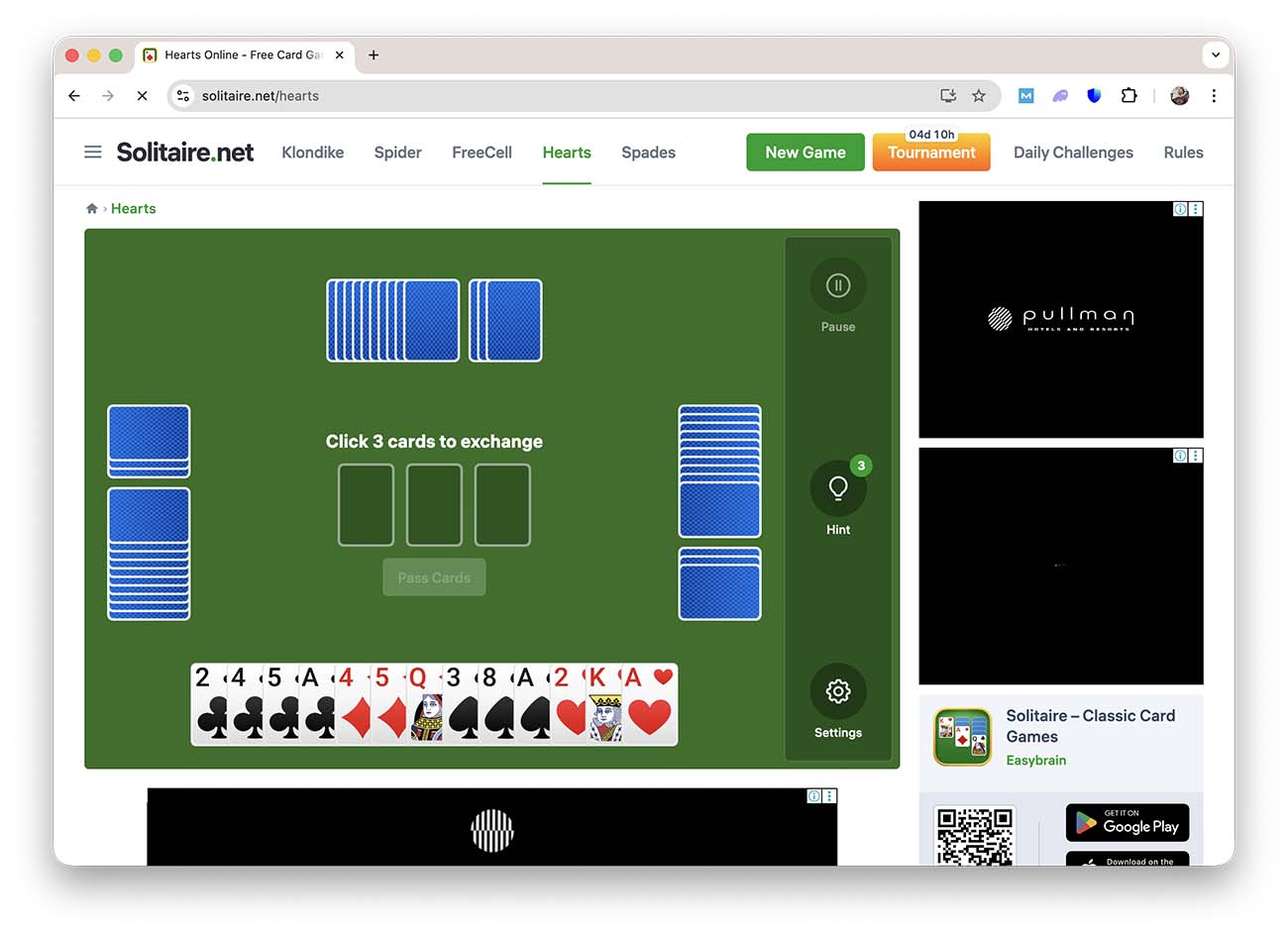
The pass is where strong Hearts players buy safety and set traps. You’re shaping your hand’s future flexibility: removing liabilities (like high spades) and engineering voids to create dumping lanes later. Because everyone passes simultaneously, the pass phase is a strategic bet under uncertainty, not a simple “get rid of junk” step.
Passing isn’t just cleanup. It’s forecasting. Most beginners pass whatever looks scary, but experienced players pass with a plan for how the next 8–10 tricks will likely unfold.
Good pass decisions usually land in three buckets:
1. Defuse catastrophic cards. The Queen of Spades is the classic landmine, but the Ace/King of spades can be just as dangerous if you’re likely to be forced into leading spades later.
2. Create a planned void. Being void in a suit early can be powerful because it lets you discard penalty cards when that suit is led. But it’s risky if you misread when that suit will be led or you lose control of tempo.
3. Keep controlled exits. Mid cards across multiple suits often beat extremes. They give you ways to duck tricks without accidentally winning them.
This is one reason online Hearts stays sticky: the pass phase is a compact strategy puzzle that resets every hand. If you’re playing a few hands on https://solitaire.net/hearts, you feel that “new puzzle” effect repeatedly without needing a long session.

Why does Hearts fit modern attention spans without being mindless?
Hearts work for modern play because it offers short, complete strategic loops: plan (pass), execute (tricks), evaluate (scores), repeat. It rewards focused attention without demanding long sessions. That matters when task switching is common and costly research summarized by the APA notes switching can waste up to 40% of productive time.
A lot of online games either demand deep time investment or they slide into autopilot. Hearts sit in the middle. Each hand gives you a clear objective and immediate feedback, which makes even a brief session feel complete.
There’s also a “fair punishment” quality to Hearts. Miss one key signal (like a player going void in clubs), and you’ll often pay for it. But if you stay engaged, the game gives you ways to recover through safer leads, controlled losses, and better endgame shedding.
That’s why Hearts can feel oddly refreshing compared to doomscrolling or multitasking. The APA’s summary of research on multitasking highlights that switching costs can be substantial up to that 40% productivity hit because the brain pays a restart penalty when bouncing between tasks. A game that keeps you in one mental lane, even briefly, can be more satisfying than it looks on paper.
How do social dynamics in Hearts stay strong even with anonymous online play?
Hearts stay socially engaging because interaction is built into the rules, not into chat. Every hand is a negotiation conducted through card play: signaling, punishing, cooperating temporarily, and occasionally applying “shoot the moon” pressure. Online anonymity doesn’t remove the social game, it concentrates it into moves.
In many online card games, social play is optional. In Hearts, it’s unavoidable. Your decisions directly affect opponents’ risk, so every trick is a subtle push-and-pull.
Players “talk” through:
— Leading choices: what suits you, signals what you think is safe (or what you want others to think is safe).
— Refusal to take control: ducking a lead can force someone else to “own” the next trick.
— Moon threats: when someone looks like they might shoot the moon, the whole table has to coordinate disruption often without explicit coordination.
This is the kind of emergent table behavior that keeps Hearts from getting stale. The same card distribution can feel totally different depending on who is cautious, who is aggressive, and who’s willing to gamble on a moon attempt.
What evidence suggests games like Hearts can support healthy cognitive engagement?
Atomic Answer: Hearts isn’t a medical intervention, but research on cognitively engaging games suggests potential links to healthier cognitive aging. For example, a BMJ Open cohort study reported board game players had about a 15% lower risk of dementia than non-players (association, not proof of causation).
It’s worth being precise: playing Hearts online doesn’t “prevent dementia.” But it is the kind of structured mental activity that researchers often study under cognitive engagement.
One widely cited example: a French cohort study published in BMJ Open found board game playing was associated with a lower dementia risk (about 15% lower) after adjustment, still an association, not a guarantee.
Why might a game like Hearts fit into that “cognitively engaging” bucket? Because it repeatedly exercises:
— Working memory (tracking what’s been played and what’s likely still out),
— Inhibitory control (resisting the tempting play that wins a trick but costs points),
— Planning under uncertainty (especially during and after the pass).
The practical takeaway isn’t “Hearts are medicine.” Hearts are active entertainment decisions, consequences, learning loops rather than passive consumption.
Why does Hearts remain culturally sticky compared to other card games?
Hearts is sticky because it’s widely known, easy to teach, and distinct in feel: a competitive game where “winning” often means avoiding capture rather than grabbing power. Survey data also suggests broad familiarity YouGov found 46% of Americans report having played Hearts, giving it a big shared baseline.
Games survive online when people already know the rules or can learn them fast. Hearts benefit from deep familiarity. In YouGov’s survey on card games, 46% of Americans said they’ve played Hearts. That shared baseline lowers friction: fewer tutorials, quicker matchmaking, faster “one more hand” behavior.
But familiarity alone isn’t enough. Hearts also has a rare mix:
— Low randomness relative to many casual games because card tracking and lead control matter.
— High replayability because each table creates different incentives.
— A clear skill signal because good players lose less often and by smaller margins.
That’s why Hearts keeps its place. It’s a classic that behaves like a modern strategy game when you put it online, and it remains easy to revisit whether you’re playing a quick session on https://solitaire.net/hearts or settling in for a longer run.